
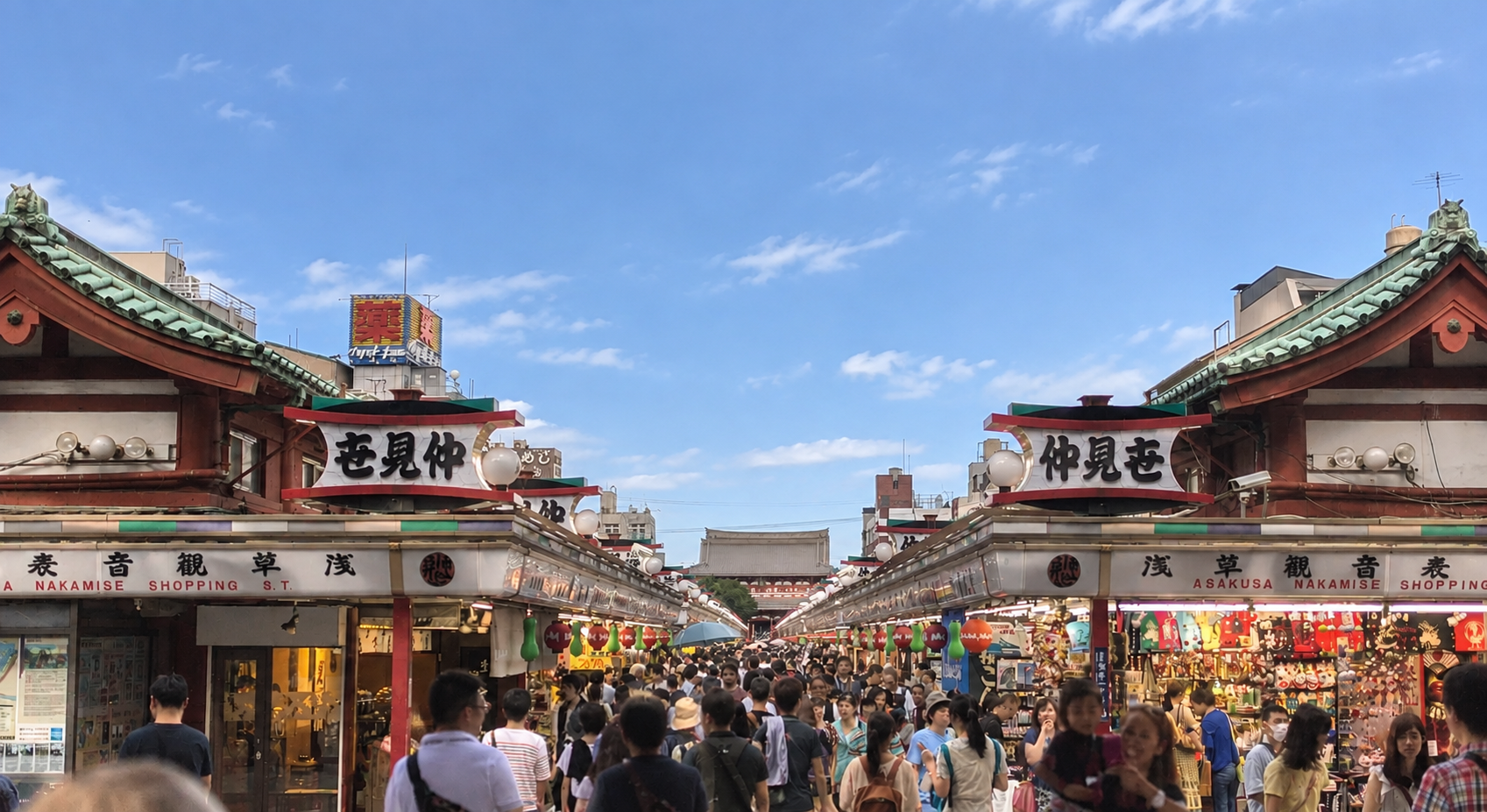
We did this the unglamorous way. We stood on the street in Asakusa and asked a hundred visitors to Japan whether they were interested in Japanese nail art.
Seventy-five of them said yes.
That was more than we expected, so we asked the obvious follow-up: then have you had it done while you’re here?
Almost none of them had.
The reason was not what you would guess
It was not price. It was not that they had changed their minds.
Thirty of them said they did not know where to go.
Twenty-five said it was the language.
Fifty-five people, standing in one of the most visited neighbourhoods in Tokyo, who wanted the thing and could not find the door.
A handful mentioned other things ― that it would take too long, that they could not tell what it would cost. Almost nobody said they were not interested enough, because we had already filtered for that. These were people who wanted it.
And a lot of them said two hundred dollars
We also asked what it was worth to them.
More than a few put it at $200 (¥30,000) or more. That was not one unusual answer ― we heard it again and again. Many said they could pay $150 (¥20,000) and up for a set hand-painted in Japan, made to their own measurements.
We have thought about those answers more than anything else we collected.
Not because we are going to charge that. Because of what they tell you about how this work looks to someone who understands what it actually is.
To those people, this was not a souvenir. It was a commissioned piece of work by a trained artist, and they priced it accordingly. They were not wrong to.
Meanwhile, on the other side of the same city
There are people in this country who can make exactly what those seventy-five were asking for.
Japan has a national certification system for nail technicians, and the shape of it says something about what the country decided to value. In the most recent testing year, around 91% of candidates passed the entry level. At the top level, out of roughly 5,100 people who sat it, about 52% passed ― a coin flip, among people who had already cleared two levels below and chosen to go further.
What that exam tests is not design sense. It is hand control, under a clock, watched. Before most artists design anything of their own, they have spent years on the same shapes and the same structures until the hand stops needing to think about it.
And what comes out of that training is, honestly, remarkable.
A detailed set is two to three hours of work, on a surface about a centimetre across, with a brush holding a few hairs. There is no undo. A line placed wrong means removing the layer and starting that nail again.
And the last stage of the work is not finishing. It is looking for what is wrong. Most of what a careful artist does at the end is completely invisible to the customer, because its entire purpose is that the customer never notices anything.
Two things that could not find each other
So here is the situation as we found it.
On one side: seventy-five people out of a hundred who wanted this, several of whom valued it at $200 (¥30,000) or more. Most of them standing a few minutes’ walk from someone who could have made it.
On the other side: artists with a decade of training, whose work is bounded by who happens to walk into one building in one city, during the hours that building is open.
Neither side was missing. They just had no way to reach each other.
That is the whole reason this company exists. Not to rescue anyone. To build the road between two groups of people who were already there.
What changes when the work moves
A hand-painted press-on set is painted on a tip, not on a customer’s hand. That one difference changes what the job is.
For the artist, the work is no longer tied to a time slot. There is a deadline, not an appointment. It is no longer tied to a place either ― it can be painted at a kitchen table at five in the morning. Her skill stops being something she can only sell by the hour, in person, and becomes something that travels. Her work reaches people in countries she has never been to.
And her name goes on it. In a salon, the customer remembers the salon. Here, the person who painted your set is named.
That last one matters more than it sounds. A great deal of extraordinary craft in this country is anonymous by default.
For the person who wanted it, the door is findable ― a page, in their language, from anywhere. They do not need to be in Tokyo, or have three free hours, or work out how to book in Japanese. And what arrives was made by a specific named person, for their own ten measurements.
How a set is made for you
It is simpler than a salon appointment, and more particular.
You choose the shape you want, and the length. You send the measurements of your own ten nails ― which are ten different sizes, and rarely match between your left hand and your right. You choose the design you like.
An artist in Japan then paints that set, for you, to those numbers.
When it is finished, it is packed by hand, with care, and sent to your country.
The thing we are actually trying to build
A platform where every person involved comes out ahead.
The artist keeps doing the work she spent years learning, on her own terms, under her own name. The customer gets something made for them by someone whose skill is real. Neither of those requires the other to lose.
We are small and we are at the beginning, and we are not going to claim we have solved anything yet. But that is the standard we are holding ourselves to, and it is the thing we check our decisions against.
Seventy-five people in Asakusa told us they wanted this. Fifty-five of them could not find the way in.
We are trying to be the way in.
You can meet the artists we work with on our Artists page.
Research note: 100 visitors to Japan, street interviews conducted in Asakusa, nationality and age sampled at random.