
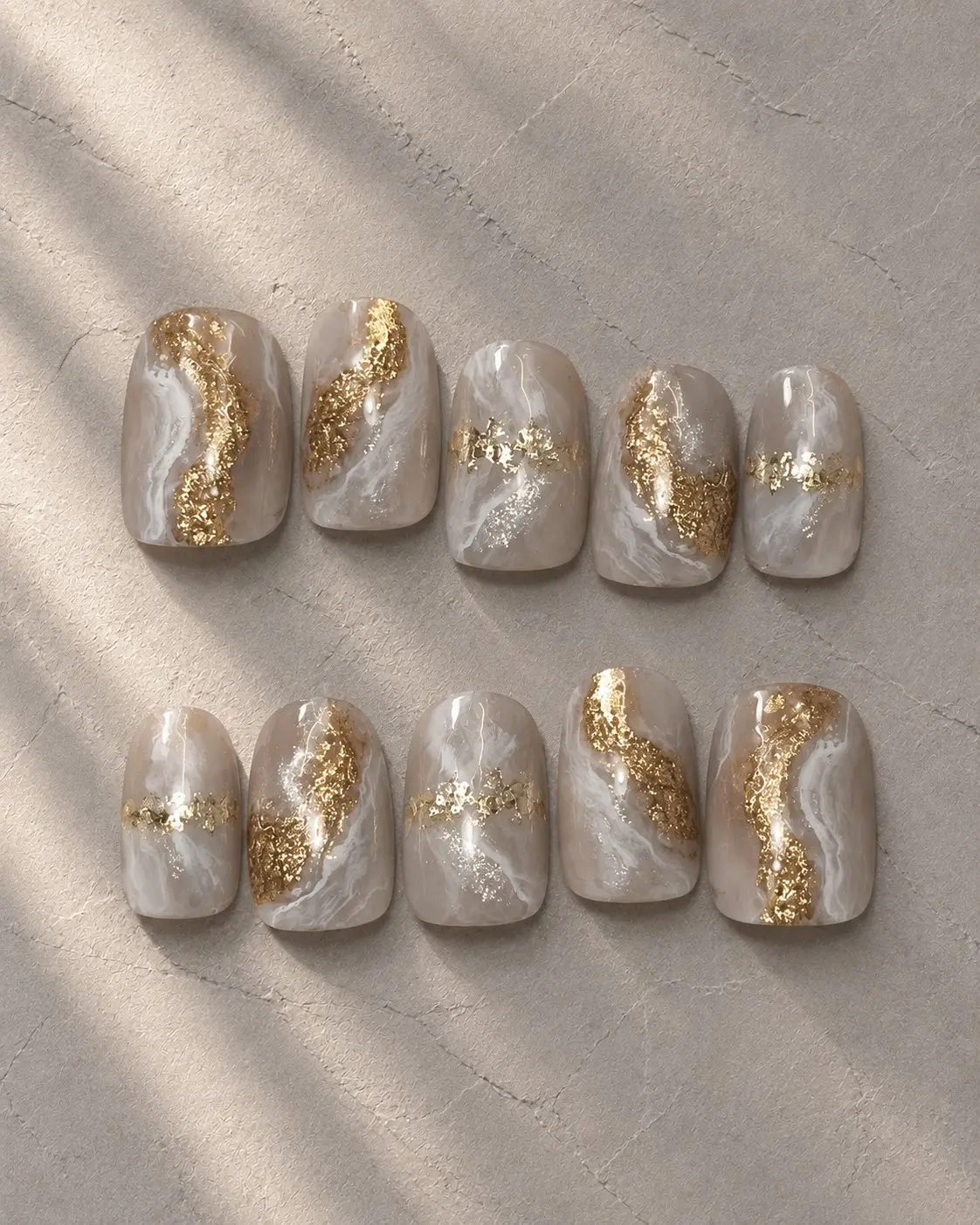
If you know Japanese nail art from the internet, you probably know one version of it: maximalist. Charms, pearls, sculpted shapes, three-dimensional pieces built up off the nail until the hand becomes a display case.
That version is real. It is also roughly fifteen years out of date.
Walk into a salon in Tokyo now and the dominant style is close to the opposite — soft, blurred, asymmetric, with no repeating motif and often no clear subject at all. It has a name, nuance, and in 2026 it became one of the most-copied nail trends in the West.
Both are Japanese nail art. This guide covers the main styles, what separates them from Korean work, and how to choose between them.
What actually makes it Japanese
Nail art exists everywhere. What distinguishes the Japanese approach is less about motifs and more about three habits of working.
Scale. Japanese nail artists routinely work at a size most people would not attempt with a brush — fine lines drawn with brushes holding only a few hairs, sculpted elements built in layers a fraction of a millimetre thick. The national certification system tests hand skill under timed conditions, and artists often spend years on foundational work before designing anything of their own.
Negative space. In traditional Japanese composition, the empty area is not leftover. It is part of the design, deliberately sized. This carries directly into nail work: the reason a single line on an otherwise clear nail reads as finished rather than unfinished is that the blank area is doing work.
Asymmetry across the set. Rather than repeating one design ten times, a Japanese set is composed as a group — one statement nail, two supporting, the rest quiet. The hand is treated as a single composition, not ten identical units.
That third habit is the one most often missed in copies of the style. It is also the reason Japanese sets photograph the way they do.
The main styles
Nuance
The defining Japanese style of the moment, and the hardest to describe, because its whole premise is being hard to describe.
Nuance in Japanese usage means something closer to “undefined” than the English word suggests. A nuance set has no motif you can name. Colour is blurred rather than bordered, edges dissolve, and the design drifts across the nail without resolving into a shape. Palettes lean earthy and muted — milk, clay, smoke, moss — with a single translucent layer or a fleck of foil to catch light.
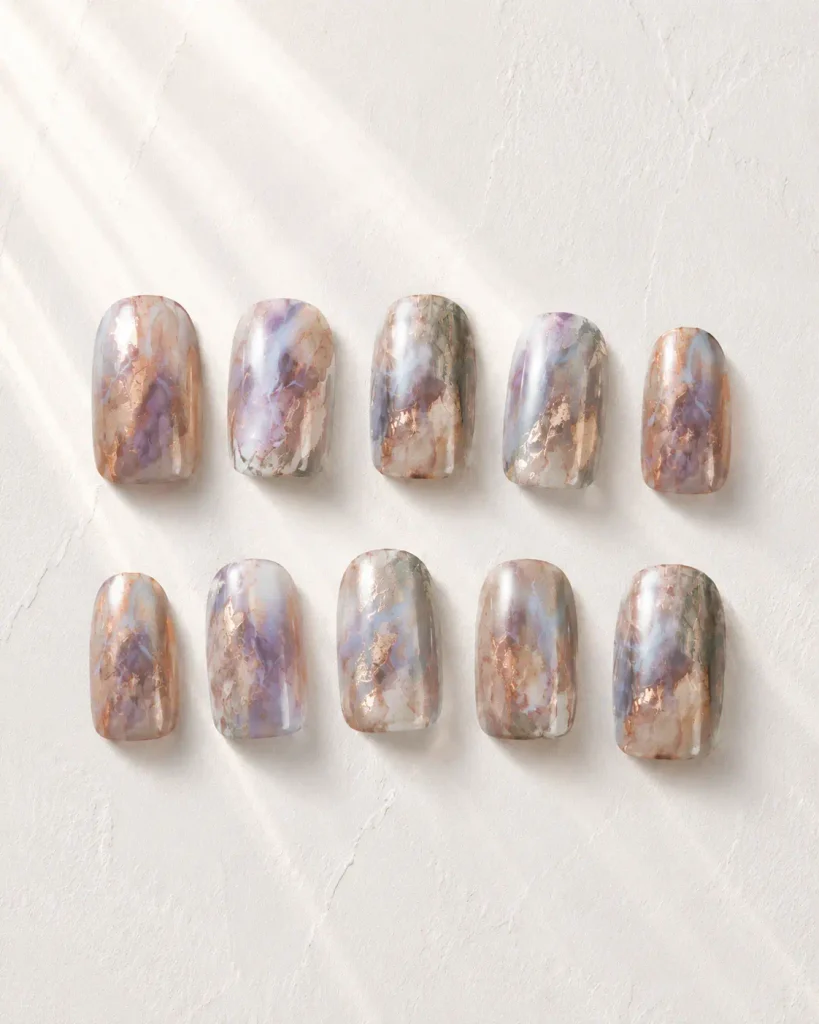
It became a trend abroad in 2026, and Western coverage has been fairly direct about where it came from: the look is “everywhere in Japan,” and visiting nail professionals have noted that the actual Japanese approach is far subtler than Japan’s reputation for over-the-top technical work would suggest
Several techniques sit under the name:
・Blooming gel — a low-viscosity clear gel. Pigment is dropped in while it is still wet and disperses on its own, producing soft marble, aura and smoke effects. The technique is Japanese in origin
・Marble ink layered under milky or jelly colour, so the pattern reads as though it is below the surface rather than on it
・Magnetic pigment, which pulls into a soft band of light rather than a hard line
What makes it difficult is that there is no template to follow. The dispersion happens while the gel is wet and cannot be corrected once cured, so each nail is a single attempt. Ten nails that look accidental have to be made to look accidental in a way that still balances across a hand.
Our nuance work is painted by Yurika → https://amoetokyo.com/artists/#artist-42, who trained in Omotesando and Ginza before working in Bangkok and California.
3D art
Sculpted elements built up off the nail surface: relief flowers, ribbons, hearts, abstract forms, and set pieces such as pearls, stones and metal parts.
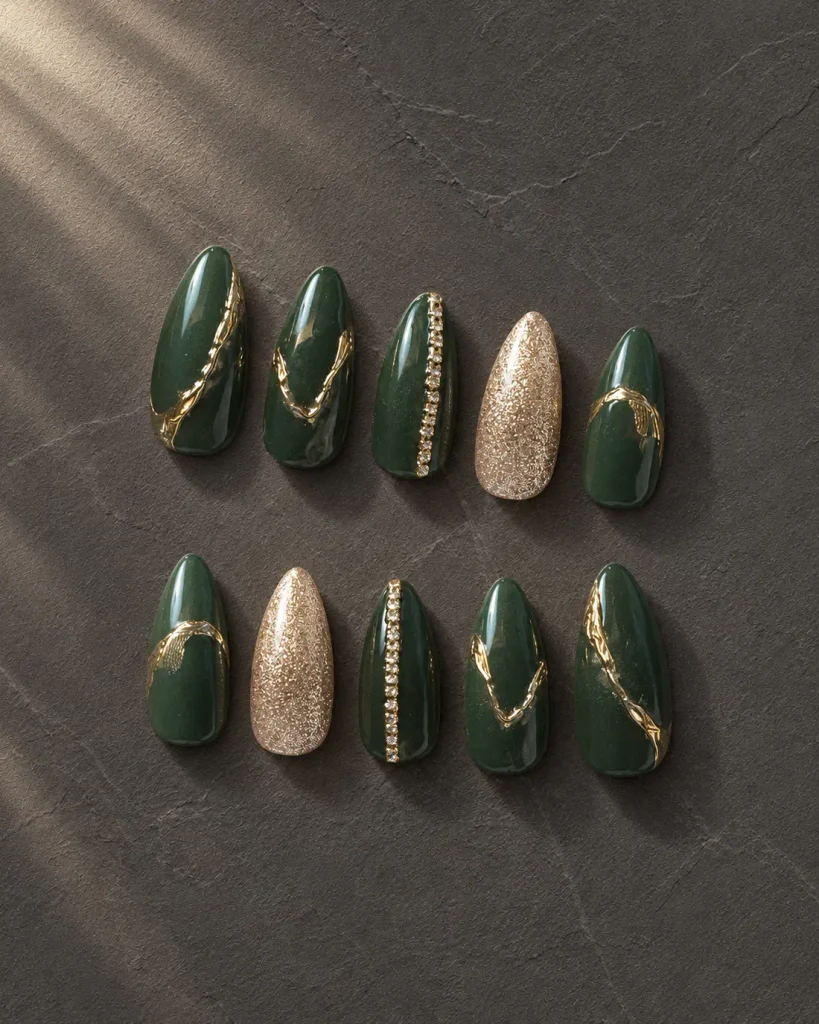
This is the style that built Japan’s reputation abroad. The deco boom of the 2000s and 2010s — nails so heavily decorated they were photographed as objects — is what most of the world saw first, and Japanese artists were doing it years before it travelled.
Technically it is the most demanding of the styles. A raised element has to be balanced, has to be light enough not to lever itself off, and has to survive a hand being used. Anything sculpted is also built in sequence, which means a mistake in an early layer cannot be fixed later.
There is one practical advantage worth knowing: 3D work travels better on a press-on tip than on a natural nail. A tip can be stored in a box between wearings, so a sculpted set survives far longer than the same design applied in a salon.
Our 3D work is made by momo → https://amoetokyo.com/artists/#artist-73, a JNA Headquarters Certified Instructor — the highest qualification awarded by the Japan Nailist Association, and one of a small number of instructors qualified to train professional nail artists.
Painterly
Miniature painting, in the literal sense. Brushwork, graduated colour, abstract composition, and in its most extreme form the reproduction of an actual artwork at one centimetre across.
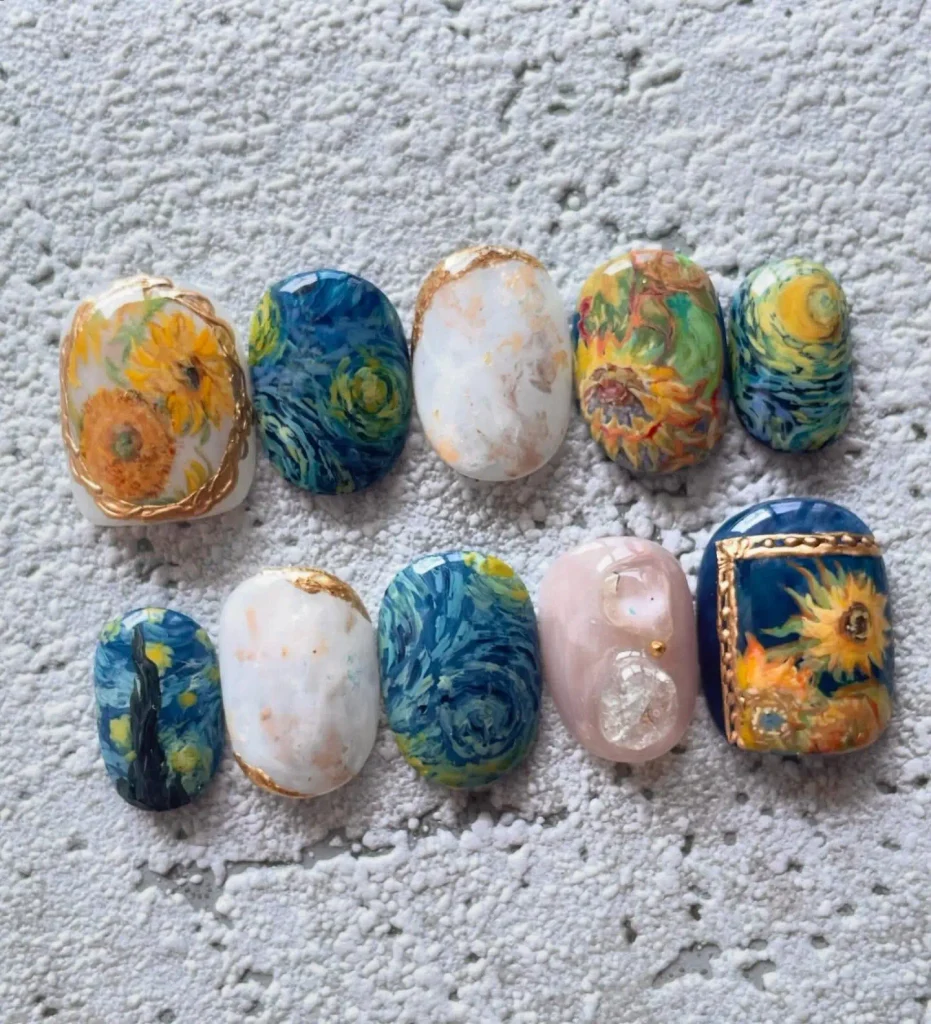
This is where Japanese training shows most clearly. Fine lines are drawn with brushes holding a few hairs, and there is no undo — a line placed wrong means removing the layer and restarting that nail. A detailed painted set takes two to three hours of work.
Painterly and nuance often appear in the same set: a soft blurred base on eight nails, with one painted as a small picture.
Our painterly work is done by Naori Yonemura → https://amoetokyo.com/artists/#artist-124, who specialises in nail art inspired by Monet and Van Gogh, and has taught the technique in Korea.
Minimal
The quietest direction, and the one most often worn by nail artists themselves: one line, one dot, a nail left almost bare. It has grown quickly among Japanese customers and it is the easiest of the styles to wear in a conservative workplace.
Traditional motifs — wagara and gold leaf
The heritage layer, and the smallest of the five in practice.
Wagara is the family of geometric patterns that have appeared on Japanese textiles, ceramics and paper for centuries, each carrying an established meaning:
・Pattern — Japanese — Meaning
・Hemp leaf — asanoha — Healthy growth
・Blue sea wave — seigaiha — Peace that continues without end
・Seven treasures — shippō — Harmony between people
Gold leaf — kinpaku — belongs to the same layer. Around 99% of Japan’s gold leaf is produced in Kanazawa, beaten to roughly one ten-thousandth of a millimetre, thin enough to move in the air from breathing. On nails it is applied in irregular fragments rather than as a sheet, so each piece catches light at a different angle.
Worth being straightforward about this: traditional pattern work and gold leaf are specialist skills within Japanese nail art, not a default. Painting asanoha at nail scale means meeting every line at the correct angle with no room to correct a drift, and gold leaf has to be handled with tweezers and never touched, because skin oil makes it stick and tear instantly. Fewer artists work this way than the volume of “Japanese-style” imagery online would suggest — which is also why a genuine traditional set is harder to find than a nuance one.
Choosing a style
The most reliable approach is to work backwards from where you will wear it.
・Situation — Works well — Why
・Office or conservative workplace — Minimal, soft nuance — Reads as groomed rather than decorated
・Wedding or formal event — Nuance with pearl, painterly — Photographs well, does not compete with clothing
・Travelling in Japan — Nuance — No upkeep, photographs well in any light
・Wanting to be noticed — 3D — Highest visual impact by a wide margin
・Wearing kimono or yukata — Anything, kept short — Long nails interfere with handling fabric and obi
One practical note on kimono: shorter is better regardless of style. Traditional dress involves constant handling — sleeves, obi, sitting and rising — and long nails get in the way of all of it.
Japanese versus Korean nail art
These two get compared constantly, and the comparison is usually framed as a ranking. It is more useful as a difference in design logic.
・Japanese — Korean
・Finish — Matte, milky, translucent layers — Glazed, glossy, uniform — “glass,” “syrup”
・Across the set — Asymmetric. Each nail different — Consistent. Ten nails as a set
・Colour — Muted, earthy, low contrast — Clear, bright, high clarity
・Where the skill shows — Hand-painting and sculpting — Surface finish and evenness
Neither is more advanced. They optimise for different things — Korean work for a flawless uniform surface, Japanese work for composition and hand skill. Plenty of artists work in both.
How it is actually made
Slower than most people expect, and in a specific order.
A nuance set is composed while the gel is still wet, because that is when the colour moves. Once cured, the blur is fixed — there is no adjusting it. A 3D set is built in layers, each cured before the next, so a problem in the base cannot be reached later. A painted set is drawn with brushes holding a few hairs, with no undo at any point.
What all three share is that they cannot be printed, stamped or automated. They depend on someone who has spent years learning to work small. That is the real reason this has been difficult to get outside Japan.
Wearing it without going to a salon in Japan
For most of its history, this meant sitting in a Japanese salon for several hours. Hand-painted press-on nails changed that: the artist paints on the tip instead of on your nail.
・No appointment, no travel. The set arrives ready to wear
・Application takes about ten minutes rather than two to three hours
・Nothing is filed or drilled, so the natural nail is not touched
・They come off the same day, which matters if your work or school restricts nails
・They can be kept and re-worn. A painted set outlasts anything done in a salon
The catch is sizing. Press-on nails that fit are difficult to tell from salon work; ones that do not fit are obvious from across a room. Your ten nails are ten different sizes and the left and right hand rarely match, so all ten need measuring.
One warning worth having: a great deal of what is sold as Japanese press-on nails is not made in Japan.
Frequently asked questions
What are nuance nails?
A Japanese style built on blurred, undefined colour rather than a motif — soft marbling, dissolved edges, muted palettes, and a different design on each nail. The word means closer to “undefined” than the English “nuance” suggests.
Is Japanese nail art only for short nails?
No, though Japanese sets do tend to be shorter than in many other markets. Short lengths also suit fine detail better — small patterns lose their proportion on very long nails.
What is the difference between Japanese and Korean nail art?
Korean work leans toward glazed, uniform finishes. Japanese work leans toward hand-painted detail and asymmetric composition across the set. See the comparison above.
Does 3D nail art survive being posted?
On a press-on tip, yes, if it is packed properly. This is one area where made-to-order tips have an advantage over a salon set — the design is never on a hand while it is in transit.
How long does a hand-painted set take to make?
Two to three hours of painting for a detailed design. For made-to-order press-on nails, add the time needed to measure and ship.
In summary
Japanese nail art is not one look. It runs from nuance — blurred, muted, deliberately undefined — through sculpted 3D work and miniature painting, to designs so minimal they are almost invisible. Traditional patterns and gold leaf sit behind all of it as a heritage layer, and are more specialist than the internet suggests.
What holds the whole category together is the technical standard: hand work at very small scale, and the habit of treating empty space and asymmetry as part of the composition rather than as mistakes.
AMOÉ TOKYO works with nail artists in Japan who paint every set by hand, to your own measurements. You can meet them on our Artists page.